





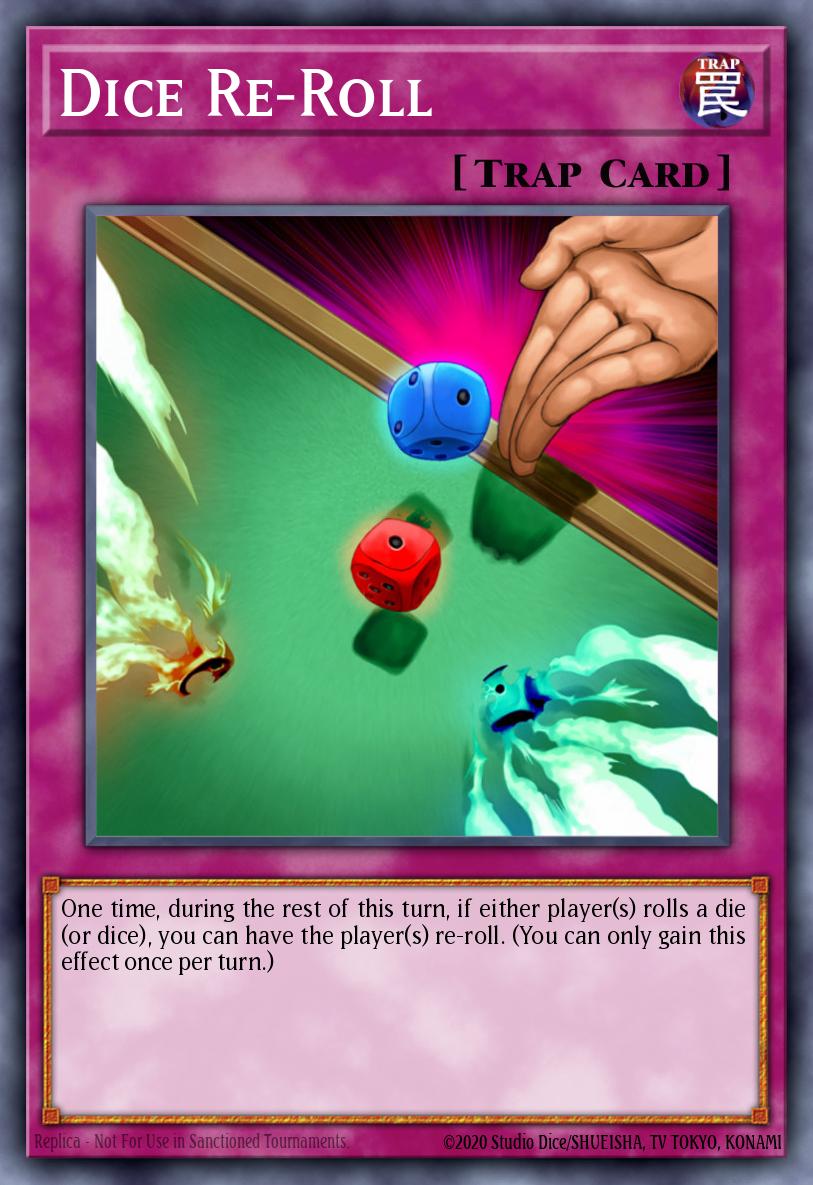

 Trap
 Normal
Dice Re-Roll
Archetype:
Dice
View:
4314
One time, during the rest of this turn, if either player(s) rolls a die (or dice), you can have the player(s) re-roll. (You can only gain this effect once per turn.)
Dice Re-Roll — Power Evaluation
Final Score: 36 ± 10 · Confidence: Medium
- Intrinsic: 34 · Deck: 37 · Meta: provisional
- Primary role: Utility · Secondary: Negation/Interaction
Why it scores here
Dice Re-Roll is a narrow, once-per-turn trap that only does something when a die is rolled, so it converts almost nothing into board or card advantage on its own. Its score comes from being a cheap, consistently included trap in dice-themed decks (3 copies in 11 of 12 sampled decks), not from raw power. No combo or guide evidence exists, so its combo role rests on text alone. High stats do not apply here, and the card's score does not rise from its popularity or view count.
Axis scores
| Axis | Score | Evidence |
|---|---|---|
| Accessibility | 40 | Set trap that needs no searcher, but no starter or searched evidence exists and it is live only on a die roll (inferred from text; 12 decks run it, 0 combo appearances). |
| Combo & Conversion | 15 | Builds nothing by itself; it only re-rolls dice, and there are no recorded boards to show otherwise (text-only inference, 0 combo appearances). |
| Resource Economy | 25 | Costs a card to re-roll one die, with no draw, search, or banish return (verified from text; no combo stat). |
| Effect & Interaction | 20 | Answers only die rolls, a narrow opponent interaction that is easy to play around (inferred from text). |
| Material Utility | 10 | Trap card with no material value (verified from card type). |
| Resilience & Flexibility | 35 | Sits in the backrow until used and can be negated by generic trap answers, with the once-per-turn limit (inferred from text; 10 distinct archetypes in decks, observed). |
| Deck-Building Efficiency | 60 | Three copies in a deck with no garnet or lock, and the partner cluster is dice-themed (observed from 12 decks, copies avg 2.83). |
Calculation
Weight profile: Utility / no clear role default (no role-blend). Intrinsic ≈ 34, Deck ≈ 37, Meta = provisional. Modifiers: none. Final formula: 0.40*Intrinsic + 0.60*Deck
Strengths
- Cheap, unrestricted trap that fits in any deck running dice, with no garnet or lock cost
- Consistent inclusion across 12 decks spanning 10 archetypes (observed)
- Once-per-turn trap that is hard to dislodge when the dice effect matters (inferred)
Weaknesses
- Narrow trigger: only changes the outcome when a die is rolled, which is rare outside dice decks
- No card advantage, search, or board conversion
- Zero recorded combo appearances, so its real starter or payoff role is unproven
- Once-per-turn limit and a single-use window
Counters / choke points
- Generic trap negation on the set backrow (inferred from text)
- Opponent simply not rolling dice, which leaves the card with no target (inferred)
Best use
Situational dice counter in dice-themed decks. Decks: Dice, Harpie, Greed. Suggested copies: 3.
Evidence & gaps
- Verified: Trap card; once per turn; re-roll effect on a die roll (card text); 12 of 12 decks run it, 11 at 3 copies (deck data)
- Observed: Top partners Dice Jar 58.3%, Magic Cylinder 50%, Cup of Ace 50% (deck data); 10 distinct archetypes, no single-home dependence (deck data)
- Inferred: Trigger is narrow and rare outside dice decks; Card does not build board or advantage from text alone; Vulnerable only to generic trap negation
- Data gaps: no combos supplied; combo conversion is text-only inference no guides supplied no usage statistics (StatisticsCard); archetype inclusion inferred from the deck sample only no banlist token; assumed 3 copies (unlimited) no top-card ranking context (top-card status false, rankings empty)